The Practice Loop: Try, Notice, Adjust
The practice loop turns a broad skill into a focused task, helping you choose a useful next move without making every session a judgement of ability.
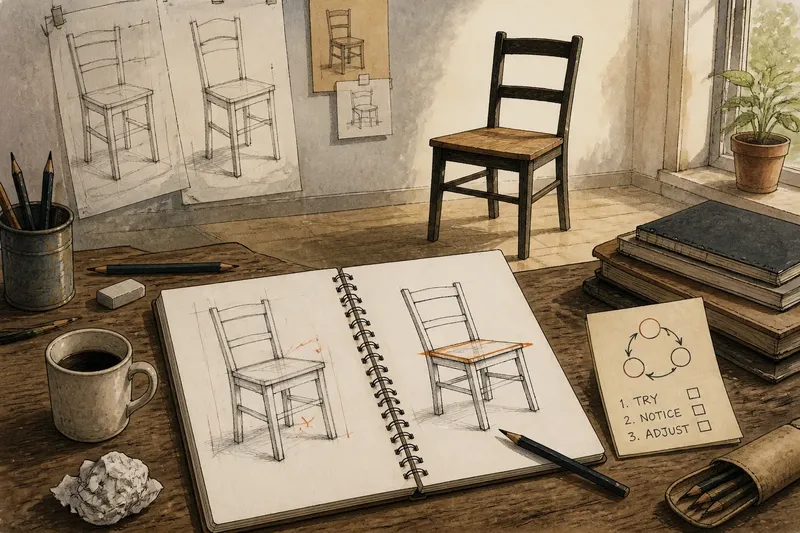
You sit down with a sketchbook to draw a chair, but the legs look uneven and the page fills with corrections. The practice loop gives this drawing session a specific purpose: choose one part to work on, make an attempt and decide what the result suggests you should do next.
The practice loop keeps a session focused
A practice loop connects a task to a decision. You choose something you can attempt, carry it out, then decide whether to repeat it, alter the task or try a different approach.
The point is not to inspect every flaw or make each attempt successful. A clear task helps you spend your attention on one part of the work, rather than treating the whole session as a judgement of your ability.
For the chair drawing, you might set aside the legs and work only on the angle of the seat. That gives you a concrete feature to attend to while you draw; it does not require you to analyse or record each attempt.
Choose a task that fits the time and materials
A useful task has a clear boundary and fits the conditions you actually have. “Improve my drawing” is too broad for one sitting. “Sketch the seat and its angle with a pencil” identifies a manageable part and the material you will use.
Make the task large enough to practise the skill you care about. If you are working on a transition between two musical phrases, a single note may not provide the necessary context; practising the short passage that contains the transition might.
- If you have a short period and one sheet of paper, choose a single shape or line; if that leaves the target unclear, widen the sketch to include its immediate context.
- If your task depends on a tool or material you do not have, choose a version that uses what is available; if that changes the skill too much, postpone that task until you can use the needed equipment.
- If the task includes several unrelated aims, select the one that matters most for this session; if the aims are inseparable, keep them together and judge the result as a whole.
- If you cannot tell what part of the work the task concerns, rewrite it with a named passage, shape, movement or stage; if it remains hard to identify, make the task narrower.
- If the task is so small that it omits the difficulty you want to practise, add enough context to include that difficulty; if the added scope becomes unwieldy, choose a shorter segment that still contains it.
- If the task depends on a reference such as sheet music or a marked outline, put that reference within reach; if it is unavailable, choose a task you can carry out without guessing at its requirements.
Use an observation to choose the next action
Notice a feature of the work rather than making a judgement about yourself. “The back legs disappear behind the seat” describes something visible; “I cannot draw” does not point to a particular action.
Choose the next action according to what you want to work on. If the seat angle is unclear, you could lightly mark that angle before drawing the legs. If another part of the drawing matters more, you can leave the angle alone and turn to that instead.
There is no need to change only one thing as a rule. When two features belong together, adjust both and decide whether the result serves the task. If the result is difficult to interpret, simplify the next attempt so the relevant feature is easier to see.
When should you repeat or change the task?
Repeat the task if it still gives you a useful way to work on the chosen skill. Change it if the conditions have shifted, the task no longer addresses your aim or the difficulty is too great to practise productively.
For example, a passage that becomes hard to play when the whole piece is included may be easier to approach as a shorter section. If that section no longer contains the transition you meant to practise, restore enough of the surrounding music to include it.
A brief note can help you resume after a break, but it need not become a record of every attempt. Write down the task and any change you want to remember, then return to the work.
What if you cannot tell what to change?
How can you make the task clearer?
Name the part of the work you want to practise, such as a sentence, a movement or a section of a drawing. If the result is still difficult to interpret, narrow the task or give it more context, whichever makes the relevant feature easier to notice.
Should you use a reference?
A reference can make a task easier to carry out when it gives you a relevant point of comparison, such as a marked outline beside a sketch. Use one that supports the skill you are practising; set it aside if it distracts you or introduces a different aim.
When should you ask someone for help?
If another person can help you identify a practical obstacle, ask a focused question about that obstacle. If the issue involves pain, persistent discomfort or equipment that seems unsafe, stop the activity and seek qualified advice where appropriate.
What if a task needs several changes at once?
Make linked changes together when separating them would make the task less useful. If you then cannot tell whether the result suits your aim, simplify a later attempt or ask someone familiar with the skill for a specific observation.
A worked example shows how to resume a task
Say you have a pencil, a sketchbook and a chair in view, and you want to draw the chair’s seat clearly. You first sketch the seat and legs, then notice that the back legs are difficult to place because the seat’s angle is uncertain. You decide that the next attempt will focus on the seat angle and lightly mark it before adding the legs.
On that attempt, the legs are easier to position, but the chair still looks tilted. You now have a choice: keep practising the seat angle, or change the task to comparing its front and back edges. If you choose the comparison, the observable result is whether those edges communicate the angle you intend; if they do not, you can return to the outline rather than adding more details.
The example does not prescribe a single correct drawing method. It shows how a specific task can shape the next decision, while leaving room to change direction when the work calls for it.
Keep the next session easy to restart
When you stop, leave yourself a simple point of re-entry: the passage to practise, the material to use or the part of the work you want to return to. For the chair drawing, that might be a note to revisit the seat angle, not a list of every uneven line.
The practice loop works best as a way to re-enter the work, not as a demand to inspect every attempt. Keep the task concrete, and let the next decision respond to the work in front of you.