Solo Rehearsal or Peer Session? Choose by the Task
Choose solo rehearsal or a peer session by the task: practise a passage independently, then use a partner’s response to clarify timing and coordination.
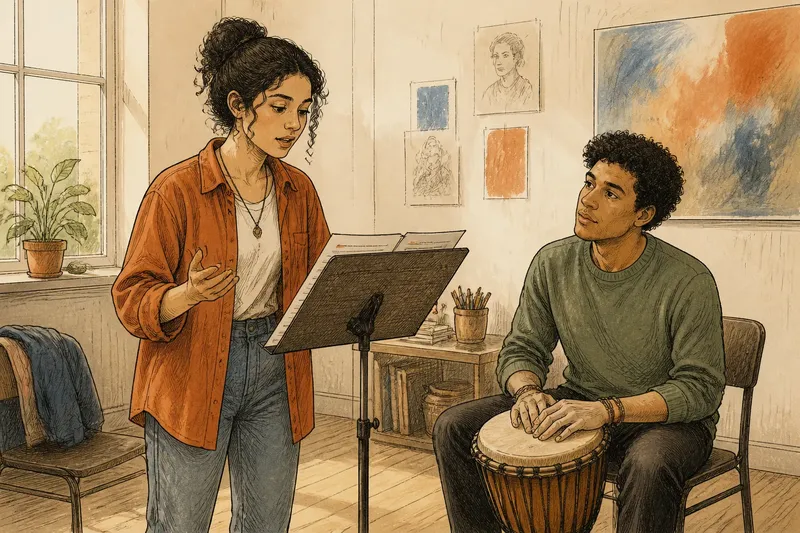
At a community arts room, Mara sets a spoken-word piece on a music stand while her friend Dev waits with a hand drum. Their first run falters: Mara loses her place, and Dev cannot tell whether to follow her pauses or the beat. This invented situation captures the choice between solo rehearsal and a peer session: practise separately when a task is individual, and meet when the work depends on interaction.
Solo rehearsal offers space for repetition and concentration. A peer session brings another person’s timing, interpretation and response into the room. The distinction is not about which setting is better; it is about what the work requires.
Identify what depends on another person
Mara needs to remember the words, speak clearly and shape the pauses. Dev needs to learn the drum pattern and notice where it should change. Their shared work includes agreeing on an opening, a pulse and an ending.
Each person can practise their own material alone. But neither can settle how the drum and pauses fit together without hearing the other. The same distinction applies to a design pair: each person can sketch ideas separately, but they need to meet to decide how the ideas combine.
Before choosing a setting, state the task plainly. “Make the opening clear” identifies a shared question; “rehearse the piece” does not.
Use solo rehearsal for concentration and preparation
Mara starts alone with the printed text. She marks two transitions where she tends to rush and reads those passages, leaving a short pause at each mark. Without the drum, she can listen to the words and work on the transitions without coordinating her pace with Dev.
Solo rehearsal suits work a person can assess independently: memorising a sequence, repeating a difficult phrase, trying instrument fingerings or preparing questions for a meeting. A recording may help someone notice pace or clarity, but it cannot provide a partner’s live timing or interpretation.
Keep the focus narrow enough to hear a difference. If Mara repeatedly recites the whole piece while the same transitions remain uncertain, she can instead isolate one phrase, try it at a comfortable pace and reconnect it to the surrounding lines.
Use a quiet solo session when repetition or private preparation is the main need.
Use a peer session for timing and shared interpretation
When Mara and Dev meet, they work on the opening rather than run the whole piece. Dev tries a steady pattern, but Mara’s pause after the first line lasts longer than expected. They discuss whether the drum should continue through the silence, then try a version in which it stops.
The exchange lets them hear how each choice affects the other. Mara can judge the rhythm’s effect on her words, while Dev can hear whether the silence is a deliberate part of the delivery. They can decide on an arrangement together rather than guess separately.
Peer sessions help with shared cues, interpretation and response: handing over a line, keeping a common rhythm, taking turns in a discussion or checking whether an instruction makes sense. A partner need not be an expert. A listener can say where attention wanders; a co-performer can describe when an entrance feels uncertain.
Agree on a small shared task, such as finding where the drum enters, before you begin.
Which rehearsal setting fits the work?
When should I rehearse alone?
Choose solo rehearsal to repeat a passage, memorise material or concentrate without coordinating with another person. Select a section you can assess independently, such as whether the words are clear or a sequence stays in order.
When is a peer session more useful?
Meet with another person when the work depends on their timing, reaction or understanding. Shared music, dialogue, paired movement and collaborative decisions all involve information that appears through interaction.
Can I use both settings in one rehearsal?
Yes. Prepare a difficult passage alone, meet to see how it works with a partner, then return to solo practice if the shared run reveals an individual difficulty.
What if my partner and I disagree about a change?
Describe the effect each person wants, then try the alternatives in a short passage. Hearing both versions can clarify whether the disagreement concerns timing, meaning or preference, helping you choose what serves the work.
Mara tests two ways to coordinate the opening
Imagine Mara has a brief rehearsal before a community reading and wants to make the opening work with Dev’s drum. Her starting point is a printed text with two marked transitions and an unsettled question: should the drum continue during the first pause? She first reads the marked lines alone, concentrating on clear words and preserving the pauses.
Next, she and Dev play the opening twice: first with the drum continuing through the pause, then with it stopping. Mara observes that the second version makes the next line stand out; Dev hears the silence as a clear cue to return. They choose the stopped-drum version and practise the hand-off into the next section together.
If Mara still rushes one phrase, she marks that phrase for another solo session rather than trying to solve the individual pacing while Dev waits. They can then meet again to check whether her adjusted pace fits the drum. Their decision is specific: practise the phrase alone, then rehearse the transition together.
Keep the two settings connected
Before finishing, Mara and Dev note which pause cues the drum, where their shared rhythm begins and which phrase Mara will practise alone. A brief note on the text or in a rehearsal notebook preserves the arrangement and makes it easier to resume.
For your own rehearsal, distinguish between what you can judge independently and what only becomes clear with another person present. If the task is concentration or repetition, work alone; if it depends on response or coordination, arrange a peer session and agree on the shared question first.
When choosing solo rehearsal or a peer session, treat the setting as part of the work’s design. A short note naming the next shared cue or individual passage can help you begin the next session in the right place.