From Apprenticeship to Open Studio: Shared Learning Through Time
Compare apprenticeship and open studios in creative practice, so you can choose the kind of guidance, peer exchange and structure your next project needs.
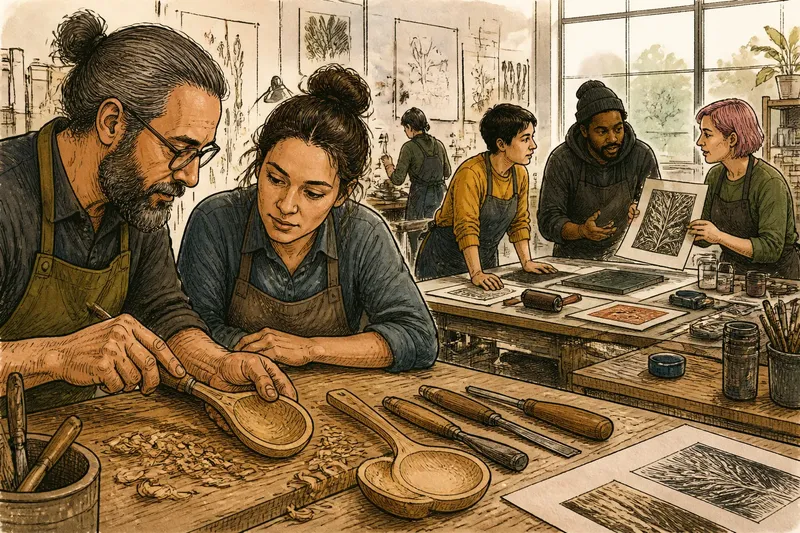
A beginner shaping a wooden spoon in a crowded workshop may learn by watching an experienced carver’s hands. Later, that same learner might bring a rough design to an open studio, where several people suggest ways to solve a stubborn curve. Shared learning in creative practice can take both forms; the history of craft learning varies across places and periods, rather than following one universal path from apprenticeship to open studio.
Apprenticeship usually means learning through sustained work alongside someone with greater experience. An open studio is a setting where people share space, tools, ideas or critique without necessarily following one teacher or a fixed route. Neither model suits every person, craft or moment: each offers different kinds of support and leaves different needs for the learner to manage.
Apprenticeship and open studios serve different learning needs
In many craft traditions, knowledge has travelled through households, workshops, guilds and other communities of work. A learner might watch, assist, copy and gradually take on more demanding tasks. Alongside technique, this arrangement can pass on ways of caring for tools, judging materials and taking responsibility for finished work.
Such arrangements have varied, and they have not always offered equal access. Entry could depend on family ties, local customs, money or permission from someone with influence. A teacher might hold valuable knowledge but have little time to explain it, while the learner’s work might be shaped more by the workshop’s needs than by personal curiosity.
Open studios and community workshops offer a different arrangement. People can work near one another, exchange ideas and learn without joining a single teacher’s household or following a fixed career path. A shared space can bring access to equipment and a mix of perspectives, but openness alone does not explain how to use tools, teach a difficult skill or decide who is responsible for safety.
Start with the knowledge you want to gain, then consider which relationship could help you gain it.
Apprenticeship can leave beginners guessing about technique
A common difficulty is the silent demonstration: the experienced maker completes a task smoothly, the learner watches, and both assume the lesson has landed. Skilled movements often include small decisions that have become automatic, such as how much pressure to apply, when to pause or what a change in sound might mean.
A learner can copy the visible gesture without understanding what it responds to. This need not mean the teacher is careless; skilled work can be hard to describe while it is happening, and a busy workshop may prioritise getting the work done.
Agree on one small learning goal before a session. A beginner might ask to see how a potter checks whether a clay wall is even, then make a comparable section and describe what felt different. The experienced maker can point out one or two signs to notice, and a short conversation afterwards can separate the underlying principle from that maker’s particular hand position.
Another difficulty is relying on one person’s judgement. An apprentice may learn a strong method for one material or tradition, then mistake it for the only sound approach. Seeing another maker work, consulting a material guide or attending a demonstration can add context without dismissing the value of close instruction.
Open studios can offer access without enough guidance
A shared studio may have skilled people, useful tools and lively conversation, yet a newcomer can still be unsure where to begin. Access is not the same as orientation: knowing that a room is open does not explain how to join a project, ask for help or find someone who can answer a technical question.
Look for a named contact, an introduction to the space and an explanation of how people offer and receive feedback. If you help organise a studio, invite newcomers to say what they are making and what support they want; do not assume everyone is ready for immediate critique.
A studio can also produce a mismatch between plentiful opinions and useful guidance. A collage artist might receive confident suggestions from people who understand colour but not the adhesives or paper involved. Comments about taste, process and material behaviour are different kinds of advice, and they do not carry the same authority.
Before showing a piece, ask for the response you need: reactions to composition, questions about the idea or suggestions about a particular material. For equipment, chemical products or another safety-sensitive matter, follow the manufacturer’s instructions and local rules, and ask a qualified person if the guidance is unclear.
Say a newcomer brings a half-finished lino print to an open studio and wants help with muddy colour. They ask two peers to comment on registration and ink rather than to give a general verdict on the image. One peer notices that the paper shifts during printing; the maker can then ask for a press-setup demonstration or try a different way to hold the sheet. The result is a clearer next question, not a ruling on how the print must be made.
Match the learning arrangement to the work
Some learning benefits from sustained attention to one person’s choices. A violinist refining bow control, for instance, may benefit from a teacher who can notice subtle changes across repeated lessons. A group session can add musical interpretation and mutual encouragement, but it may not provide the same focused guidance.
Other tasks benefit from a group’s range of ideas. A community mural team might explore visual themes, consider how a design reads from different distances and coordinate contributions. No single expert needs to dictate every choice, but the project still needs someone to clarify constraints and help resolve practical disagreements.
Many creative activities combine both forms. A learner might receive close instruction in throwing a basic vessel, then join a pottery studio to compare glazing ideas and see how others approach form. A beginner may first need demonstration and close correction; a more experienced maker may later want critique, collaborators or room to experiment.
Ask whether your main challenge is gaining a safe foundation, understanding a technique, developing an independent point of view or making something with others. The answer may point towards one-to-one teaching, peer exchange, open studio time or a combination.
Shared learning needs deliberate ways to include people
Apprenticeship and open practice both depend on who gets invited in, whose knowledge counts and who feels able to speak. In a workshop, an informal invitation may be the only route into a useful relationship. In an open studio, established habits can make newcomers feel like visitors rather than participants.
Unclear costs, inaccessible rooms, unexplained jargon, limited tool access or assumptions about when people can attend may narrow participation. These are features of how a space is organised, not simply signs that an individual lacks confidence. Good intentions alone do not remove practical barriers.
When choosing a shared learning space, notice whether newcomers receive an introduction, whether routines are explained and whether people can ask for a demonstration without being mocked. Consider whether someone unfamiliar with the group’s vocabulary can still take part. These observations help you judge how the space handles questions and participation; they do not establish its history or represent every person’s experience.
Organisers can make expectations explicit and share opportunities to teach. One participant might lead a short demonstration while another explains the studio’s routines to a newcomer. This recognises different kinds of expertise without placing all authority with one person.
Which shared learning arrangement fits this moment?
What is apprenticeship in creative practice?
It is learning through sustained work with a more experienced maker, often by observing, assisting and gradually taking on tasks. Its strength is close exposure to a craft’s habits and standards; its value depends on whether the learner can ask questions, receive explanations and develop their own judgement.
How does an open studio support learning?
An open studio brings people together to make work in shared space, often with chances to exchange feedback, tools or knowledge. It can offer contact with peers and different approaches, but a learner may need to ask for specific guidance rather than expect a structured course.
Can a learner use both models?
Yes. Focused instruction can help with a technique, while a peer setting can offer new interpretations, discussion and the experience of making alongside others.
How can I tell whether a shared space is welcoming?
Notice whether newcomers receive a clear introduction, whether people explain unfamiliar routines and whether feedback is offered with consent. A welcoming space makes it possible to ask for help without requiring you to follow every suggestion.
Choose a learning relationship that can change
The move from apprenticeship to open studio is better understood as an expansion of possible relationships than as a replacement of one by another. Close mentorship can pass on knowledge that is difficult to learn at a distance; open practice can make room for several kinds of expertise. Either arrangement can falter when access, authority or expectations remain unspoken.
When comparing shared learning in creative practice, begin with the work in front of you. If you are unsure whether a technique is safe or sound, seek an appropriately qualified teacher; if you want ideas for a composition, a thoughtful peer conversation may open a new direction. Choose the setting that addresses your present need, and leave room to change it when that need changes.
As your work develops, check whether the arrangement still helps you make decisions. If you can explain more of your choices, ask sharper questions and take a more active part in the community around your craft, the relationship is giving your learning room to grow.